





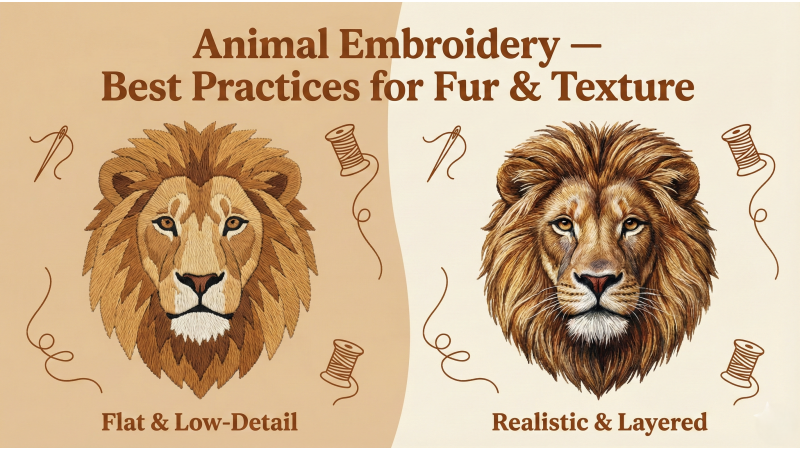
Animal Embroidery: Best Practices for Fur & Texture (Make Fur Look Real)
Animal embroidery is one of the most visually striking—and technically demanding—areas of digitizing. Whether you’re stitching a fluffy puppy, a majestic lion’s mane, a sleek horse, or a feathery bird, the goal is the same: believable texture, natural flow, and dimensional shading. When fur and feathers are done wrong the result looks flat or chaotic; when done right the design looks alive. Below is a practical, in-depth guide covering workflow, stitch choices, layering, color blending, and finishing techniques that professional digitizers use to create realistic animal textures.
Useful reading & visual references
If you want to dive deeper after reading this guide, start with articles and tutorials on realistic fur techniques such as the Magnetic Hoop primer on mastering fur embroidery and Hooptalent’s practical post on machine techniques for realistic textures. For a broader library of animal motifs and download-ready designs, check MaggieFrames’ ultimate guide to animal embroidery design downloads and the comprehensive animal categories at EmbDesignTube – animal appliqué.
1. Study real fur & feather direction first
The single most important rule is to follow natural hair or feather flow. Fur never points randomly—each region has its own directional logic. Break the animal into logical zones (muzzle, cheeks, neck, chest, body, legs, tail) and digitize each zone with its own dominant angle.
- Dogs: cheek fur usually fans outward, muzzle strokes point forward. See practical dog texture examples at dog appliqué.
- Cats: short, fine strokes and tighter layering near the face; check cat examples at cat embroidery.
- Elephants: rough, directional textures and wrinkle shading—study concepts at elephant appliqué.
2. Layer your stitching—base, mid, top
Realistic fur is built, not painted. Use multiple layers:
- Base layer: low-density tatami or center-walk fill to establish value and shadow.
- Mid layer: directional medium-length stitches that lay over the base to build body and mid-tone fur.
- Top strands/highlights: short, tapered strokes and single-strand-like lines to simulate visible hairs and catch light.
This layered approach works for many species; for example, the layered mane technique is critical in designs like horse appliqué—see horse designs.
3. Density: soft vs. thick fur
Density determines whether fur looks plush or stiff. Guidelines:
- Soft fur (kittens, puppies): lighter density, shorter stitches, more top-strand highlights.
- Medium fur (wolves, foxes): moderate density with layered directional strokes.
- Dense/coarse fur (lions, bears): higher density in base layers but still avoid overpacking—use longer mid strokes and defined highlights.
On bulky fabrics (hoody fleece, towels) reduce density across the board to avoid stiffness and thread buildup.
4. Color blending: use short overlapping stitches
Natural fur has subtle gradients. Use 3–5 tones from the same color family and blend with short, overlapping directional stitches so transitions read as soft gradations rather than hard bands. Examples of animal color approaches are visible in panda and fish motifs—compare panda appliqué and fish embroidery for contrast-handling techniques.
5. Highlights & shadows: sculpt with stitch length
Use short, bright-color stitches for highlights and slightly longer, darker strokes for shadows. Place highlights where light would naturally hit the fur (bridge of muzzle, top of ears, crest of mane). Subtle highlight strands around eyes and nose add life and expression—this is essential in cat and dog portraits.
6. Vary stitch length for natural taper
Tapering strand ends makes fur look organic. Use variable stitch lengths that shorten at tips. Tapered stitches can be simulated by overlapping shorter stitches or using micro-stitch endpoints where your software allows.
7. Use run-stitch whiskers & fine details last
Whiskers, thin facial lines, or small feather barbs should be added as delicate run-stitches after the main fur layers are complete. Adding these details last keeps them crisp and prevents them from getting buried by subsequent fills. Practical run-stitch detailing appears frequently in animal appliqué libraries such as this collection.

8. Machine settings, needles & thread
Use sharp needles sized appropriately for fabric (75/11 to 90/14 depending on garment weight). Choose thread type carefully—polyester for durable sheen, cotton/silk blends for a softer, matte look. Reduce top tension slightly for fluffy textures and test frequently.
9. Stabilizer & underlay
Proper underlay stabilizes the fur base and prevents sinking. Use center-walk or edge-walk underlay for most animal textures; add cutaway backing for stretchy fabrics. For lightweight fabrics, a light no-show mesh helps keep the surface soft without stiffening.
10. Break large areas into mini sections
Never digitize a large fur area as a single fill. Break it into smaller planes that follow muscle or fur flow—this avoids flatness and gives micro-directionality to the coat. For example, divide a lion’s mane into segments with differing angles rather than one huge block.
11. Species-specific notes & examples
- Cats: fine, short strokes—see cat appliqué examples at cat embroidery.
- Elephants: use textured, coarse strokes and deep shadowing—review elephant designs.
- Dogs: focus on expression and eyebrow highlights—examples: dog appliqué.
- Pandas: strong contrast regions require careful edge blending—see panda appliqué.
- Horse: flowing mane and tapered strokes are critical; explore horse appliqué.
- Fish & crustaceans: scale texture and directional flow—compare fish designs and crab appliqué techniques.
- Birds: feather layering is similar to fur but requires precise micro-directional fills—see inspiration at bird designs.
12. Watch expert demonstrations
If you learn visually, review step-by-step videos that show layer-building and texture techniques—for example, check these tutorials: fur texturing demo, animal portrait tips, and advanced stitch layering techniques.
Final checklist before production
- Did you segment fur into natural zones and set direction per zone?
- Is there a low-density base + directional mid layer + top highlight strands?
- Are densities balanced for the target fabric?
- Are colors blended smoothly across 3–5 tones?
- Are whiskers and small details digitized last as run-stitches?
- Did you test-stitch on the actual garment or fabric?
Mastering animal fur and texture is a mix of observation and technique: study reference photos, plan zones, layer carefully, and test repeatedly. With these methods—and by consulting the articles, libraries, and videos above—you’ll produce animal embroidery that reads natural, textured, and highly professional every time.

Leave a comment