





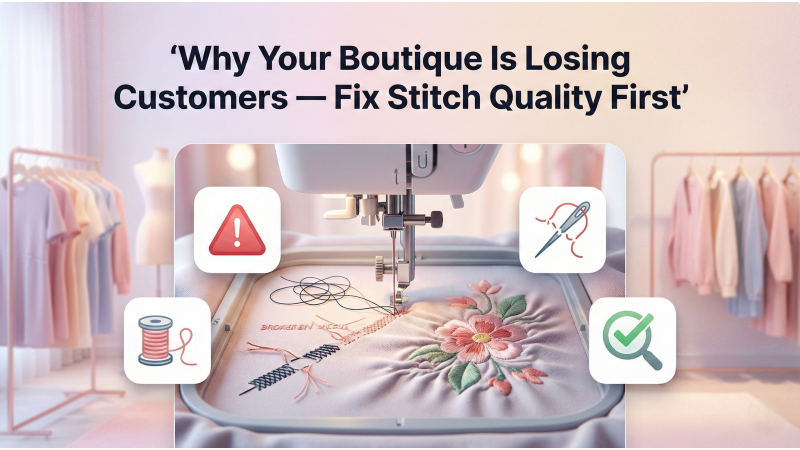
Why Your Boutique Is Losing Customers — Fixing Stitch Quality First
A boutique survives on trust stitched between fabric and customer expectations. When that stitch is weak, even the most stylish catalog collapses. Before blaming marketing, pricing, or competitors, you must examine the true heart of your boutique: your stitch quality.
Many boutiques unknowingly lose customers due to finishing flaws rather than fashion flaws. Even one uneven motif or one irritating backside stitch can push a customer away. Understanding this is the first step toward rebuilding your boutique’s reputation. For a deeper look at why boutique problems happen, guides like this troubleshooting article on common boutique issues can help widen your perspective.
Furthermore, watching real workflow breakdowns—such as insights from this video on professional fabric handling—can highlight how small technical mistakes grow into customer dissatisfaction.
1. Low-Quality Stitching Damages Your Boutique Brand
Customers notice imperfections faster than you imagine. A tiny loose thread, slightly crooked alignment, or fuzzy edging speaks louder than the talent behind your design. Stitch quality silently communicates the value of your brand. If the finishing feels cheap, customers assume your entire boutique operates below standard.
Modern shoppers compare your embroidery with export-quality garments and polished online stores. If your finishing looks dull or inconsistent, they simply move on. Videos like this breakdown of embroidery finishing improvements remind us that small refinements elevate your brand image instantly.
2. Wrong Density and Tension Cause Most Problems
Stitch density and thread tension form the skeleton of any embroidery design. When density is too high, the fabric becomes stiff and overloaded. When it’s too low, customers see unwanted gaps and a “cheap” finish. Likewise, incorrect tension creates looping, bird nesting, and inconsistent outlines—major red flags for boutique visitors.
- Thread breakage during stitching
- Stiff or bulky motifs on soft garments
- Uneven backside stitching
- Color inconsistency across a single motif
- Increased machine strain and needle damage
Fixing density and tension improves smoothness, comfort, and motif durability instantly. For example, this instructional video on thread tension behavior can give you visual clarity on what balanced stitching truly looks like.
3. Poor Hooping = Puckering + Crooked Designs
Hooping mistakes are silent destroyers of boutique quality. If your fabric isn’t hooped firmly and evenly, your design shifts and puckers—leaving the garment looking wrinkled and unprofessional.
Good hooping ensures:
- Accurate placement
- No fabric distortion
- Smooth stitch flow
- Consistent alignment
Combine the correct stabilizer (cut-away, tear-away, water-soluble) with proper tensioning, and your embroidery instantly looks more premium.
4. Cheap Thread and Needles = Expensive Loss
Trying to save money on thread or needles often creates bigger losses later. Low-quality thread breaks, fades, and frays. Weak needles leave holes, skip stitches, and irritate the skin. Customers may stay silent, but they simply won’t return.
Good-quality materials lead to:
- Cleaner lines
- Improved durability
- Better tension control
- Faster production

5. Customers Expect Boutique-Level Finishing
We now live in a comparison-rich world. Customers weigh your boutique’s embroidery against top-tier brands, online stores, and viral social media outfits. They don’t just want colors and motifs—they want:
- No loose threads
- No puckering
- No irritating stitches on the backside
- Soft, balanced embroidery that moves with the fabric
As retail competition increases, reports like this deep analysis of customer loss in retail show how even big companies lose loyalty when quality standards fall—even slightly.
6. How to Improve Stitch Quality Fast
You don’t need new machinery—just better habits. Small adjustments can transform your boutique’s finishing levels dramatically.
- Maintain correct thread tension for each fabric.
- Select the right needle type and size.
- Use quality stabilizers based on material.
- Optimize stitch density.
- Keep machines clean and well-oiled.
- Always sample-test designs.
Even watching skilled professionals work—such as in this hands-on embroidery demonstration —gives clarity on where boutique finishing typically fails.
7. Why Customers Come Back When Stitch Quality Improves
Stitch quality builds loyalty. When garments feel smooth, last longer, and look perfectly finished, customers return naturally. They also refer others without being asked. Good stitching is quiet marketing—it speaks through touch, comfort, and elegance.
Benefits:
- Better comfort on skin
- Stronger durability
- Fewer returns and complaints
- Premium boutique reputation
- Customer trust and repeat purchases
Conclusion
If your boutique is losing customers, fix your stitching—not your pricing. Even small improvements in tension, density, hooping, materials, and finishing elevate your boutique instantly. As your stitch quality rises, so does your customer loyalty. Focus on the foundations, and your boutique will grow steadily, beautifully, and sustainably.
Leave a comment