





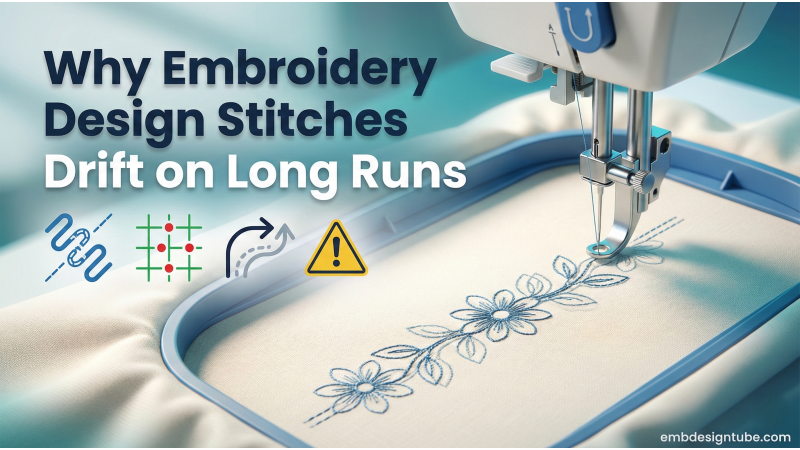
Why Embroidery Design Stitches Drift on Long Runs
One of the most confusing embroidery issues is when stitches begin perfectly aligned but slowly drift out of place during long runs. This drifting can cause uneven outlines, misaligned details, and distorted shapes, especially on designs with long satin columns, long fill segments, or repeating directional stitching.
Stitch drift is usually a combination of fabric movement, push and pull distortion, poor stabilization, density imbalance, or mechanical stitching tension. Below is a complete guide that explains the real reasons behind drifting stitches and how to fix them in actual embroidery production.
1. Fabric Movement During Long Stitch Runs
As the embroidery machine stitches continuously in one direction, the fabric can slowly shift inside the hoop. Even a small shift becomes large enough to misalign outlines later in the design. Real community cases show that stabilizer failure is one of the most common causes of mid-design drift, especially with long runs.
For example, a user report on Reddit described that their projects “start out taut but halfway through end up loose-ish,” indicating stabilizer collapse. You can read this community experience here: Reddit Case on Fabric Loosening.

2. The Push and Pull Effect of Stitch Direction
Every embroidery stitch causes tension on fabric. Push and pull distortion happens when stitches push fabric outward in the direction of stitching or pull fabric inward at the start and end of long runs.
A complete downloadable PDF explanation is available here: DigitizingFactory Push & Pull Guide.
This effect is unavoidable but can be controlled with proper digitizing techniques such as compensation, balanced stitch direction, and underlay control.
3. Poor Stabilizer Choice or Insufficient Stabilization
A weak or wrong stabilizer lets the fabric flex during stitching, leading to drifting. Long satin stitches especially exaggerate movement.
360 Digitizing Solutions explains in detail how design shifting commonly happens due to fabric slip, hooping issues, and poor stabilizer usage: 360 Digitizing Solutions – Misalignment & Shifting Causes.
If your design includes long runs or high-density areas, always use a firm cutaway stabilizer for knits and stretchy fabrics.
4. Puckering and Fabric Distortion During Stitching
Puckering is not just a cosmetic issue. It physically pulls fabric inward and shifts the design alignment as the machine runs. This leads to drift later in the design.
DigitizingMadeEasy explains how improper tension, unstable fabric, and density imbalances cause this shifting: Puckering Prevention Guide.
Kimberbell also lists the most common reasons for puckering, many of which overlap with stitch drifting: Kimberbell – 5 Causes of Puckering.
5. Incorrect Stitch Density or Excessively Long Stitches
Long satin stitches or dense fill areas can cause fabric to bunch, stretch, or distort. This distortion leads to outlines and details drifting out of alignment later in the design.
A helpful guide explaining how long stitches and looping problems occur is available here: LindeeG Embroidery – Stitch Looping & Density Issues.
6. Hooping Issues: Fabric Not Fully Secure
If the fabric is not hooped firmly enough, even slight slack will cause drifting during long runs. Reddit discussions also show that sudden misalignment during stitching is often due to hoop slip or loose hooping tension.
Read an actual user example of sudden shifting here: Reddit – Sudden Misalignment Case.
Always ensure: - Fabric is drum-tight - Stabilizer is hooped together with fabric when needed - No wrinkles exist inside the hoop - Hoop screws are fully tightened
7. Machine Speed and Vibration Effects
Running the machine at very high speeds increases vibration and movement. This can loosen the fabric inside the hoop and cause tiny misalignments that turn into drift over time.
Lowering the speed helps significantly when working with delicate fabrics, long satin columns, or large fill areas.
8. Digitizing Errors That Cause Drift
Even well-hooped fabric can drift if the design is digitized without compensation. Long stitches, repeated directional patterns, or insufficient underlay can all cause shifting.
For digitizing corrections, you can always refer to resources or request custom fixes at: EmbDesignTube.
How to Fix Stitch Drift on Long Runs
- Use a stronger stabilizer such as medium or heavy cutaway.
- Add a second layer of stabilizer for stretchy or slippery fabrics.
- Hoop fabric firmly, ensuring it is completely smooth and taut.
- Lower machine speed for long satin stitches and dense designs.
- Add underlay to reduce fabric movement.
- Apply proper push and pull compensation in digitizing.
- Increase hoop size only when necessary; smaller hoops provide better stability.
Conclusion
Stitch drifting during long runs is a common problem but completely preventable with proper stabilization, thoughtful digitizing, and good machine setup. By understanding how fabric moves, how tension affects stitching, and how stabilizers support the entire embroidery process, you can eliminate drifting and achieve cleaner, more professional results.
Related Products
Leave a comment