





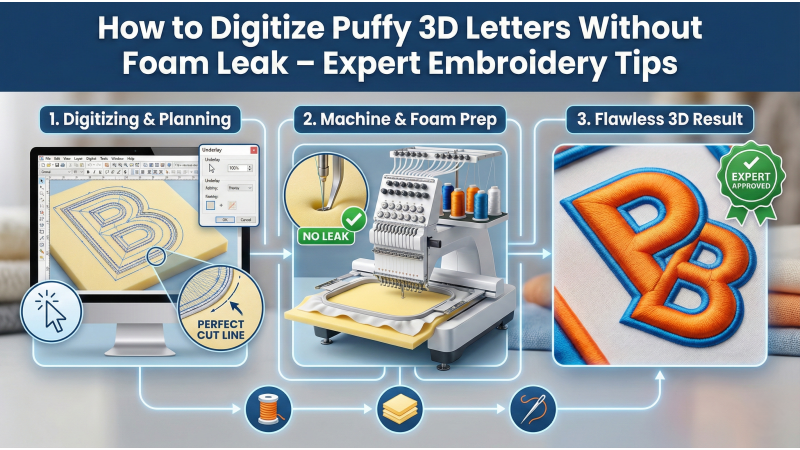
How to Digitize Puffy 3D Letters Without Foam Leak – Complete Expert Guide
Puffy 3D embroidery is a premium, sculpted technique used widely on caps, jackets, hoodies, varsity wear, and branding merchandise. Its raised, dimensional look gives designs an unmistakable richness. Yet beneath this polished effect is a technique that demands precision. Foam leakage—where the EVA foam pokes out from under satin stitches—is the most common issue digitizers face. Luckily, every leak has a fix once you understand the right method.
Before diving into the technical details, it helps to see how professional puff behaves in real stitching. This overview of real 3D puff lettering illustrates the importance of correct digitizing and foam-handling technique.
Introduction to 3D Puffy Digitizing
3D puff embroidery uses a special EVA foam placed under satin stitches. As the needle punctures the foam repeatedly, it forms a raised effect. After stitching, excess foam is peeled away, leaving clean, sculpted letters. But unlike flat embroidery, puff requires strict digitizing rules because the foam must be sliced, compressed, and completely hidden.
- No underlay beneath satin columns
- Increased density for clean foam cutting
- Wide satin columns (3.0–6.0 mm)
- Correct stitch angle to perforate foam
- Sharp needles for slicing
- Proper pathing with capped ends
To understand why these rules matter, explore how foam interacts with stitching in this deeper technical breakdown of professional puff embroidery behavior.
What Causes Foam Leakage in Puffy 3D Letters
1. Satin Stitch Too Narrow
Satin stitches below 2.8–3.0 mm fail to slice foam effectively, leaving open edges. Thin fonts are the main culprits.
2. Low Density
Puff requires heavier density than flat embroidery because the foam must be fully perforated. Low density leads to foam pushing through the stitches.
3. Incorrect Stitch Angle
Angles that do not hit the foam properly cause weak cut lines, especially on curved areas.
4. Unnecessary Underlay
Underlay must be removed completely. It acts like a cushion and prevents the satin from sinking into the foam.
5. Poor-Quality Foam
Foam quality is often ignored, but it matters more than most digitizers realize. Only proper 3D embroidery-grade foam slices cleanly. Learn more about professional-grade puff foam at this official 3D puff foam guide.

6. Dull Needle
A dull needle pushes the foam instead of perforating it, causing ragged edges.
7. Wrong Thread Tension
If tension is too loose, the satin does not compress the foam; if too tight, the satin collapses.
8. Incorrect Digitizing Path
Wrong sequencing leaves open ends. Puff requires specific pathing and capping techniques so the foam stays sealed.
Best Practices for Digitizing Clean 3D Puffy Letters
1. Increase Satin Stitch Width
Puff needs wide satin columns:
- Minimum: 3.0 mm
- Ideal: 4.5–6.0 mm
- Maximum: 7.0 mm
Narrow fonts should be manually thickened for puff. This clear visual example of stitch-width adjustments can be seen in this puff lettering demonstration.
2. Increase Density for Strong Foam Cutting
Foam requires high-density satin:
- 0.25–0.35 mm spacing
- 50–60% more density than flat satin
This forces the foam to break cleanly when removed.
3. Do Not Add Underlay
Underlay must be turned OFF:
- No center walk
- No edge run
- No zig-zag
The satin must lie directly on foam for clean cutting.
4. Adjust Pull Compensation
- 0.2–0.5 mm pull compensation
- More for stretchy fabric
- Less for structured fabric
This ensures foam stays hidden under the satin edges.
5. Use Sharp Needles and Professional Foam
Needles:
- 75/11 sharp needle (standard)
- 80/12 sharp for thick caps
- Titanium for long runs
Foam:
- Embroidery-grade 3D puff foam
- Thickness: 2 mm or 3 mm
- EVA-based foam for clean perforation
To explore professional foam options with detailed usage tips, review this official foam demonstration library.
Additional Expert-Level Techniques
1. Proper Letter Pathing
Start inside the letter, finish at the cleanest edge, and avoid travel runs inside puff zones.
2. Capping Technique for Open Letters
Letters like A, R, M, N need a small satin “cap” at the open ends to keep foam sealed.
3. Avoid Running Stitches Inside Puff Areas
Disable auto tie-offs and unnecessary travels inside the foam region.
4. Stitch Direction Strategy
Use strategic stitch angles—30°, 45°, 135°—to perforate foam cleanly.
5. Knockdown Only When Necessary
Use knockdown stitching only when dealing with extreme textures or seams—never directly under the puff itself.
For a deeper understanding of why puff embroidery is profitable and how it works commercially, study this detailed insight: Why 3D Puff Is a Profitable Technique.
Cap Embroidery Tips for 3D Puff
1. Hooping Correctly
Tight, smooth hooping is critical. Loose caps cause foam movement and leaks.
2. Stitching Over Cap Seams
- Use 90/14 sharp needle
- Slow down speed slightly
- Increase upper tension
Troubleshooting Foam Leakage
Problem 1: Foam Shows at Edges
Cause: Low density
Fix: Increase density, improve pull compensation, tweak angle.
Problem 2: Foam Sticks Out at Corners
Cause: Missing capping stitches
Fix: Add capping columns.
Problem 3: Foam Tears Unevenly
Cause: Dull needle or poor-quality foam
Fix: Replace needle, use proper puff foam.
Problem 4: Satin Collapsing
Cause: Overdensity or tension issues
Fix: Reduce density and check tension.
Problem 5: Thin Letters Look Distorted
Cause: Narrow satin columns
Fix: Widen columns or choose bold fonts.
To learn how professionals clean up leftover foam and achieve perfectly finished results, check out this advanced guide on removing excess puff foam cleanly.
Testing Before Final Production
Run a full test using the same materials: real foam, real fabric, normal stitching speed. Peel away foam carefully and inspect edges. Adjust density, pull compensation, and stitch angle until perfect.
Final Tips for Perfect Puffy 3D Letters
- Always test one letter first
- Use embroidery-grade puff foam
- Select bold fonts
- Use sharp needles
- Turn off underlay
- Increase density
- Apply proper pull compensation
- Use correct pathing and capping
- Optimize stitch angles
- Use a heat gun to melt micro foam particles
With the correct technique and materials, your puff lettering will always come out sharp, bold, and factory-grade—without a hint of foam leakage.
Related Products


Leave a comment