





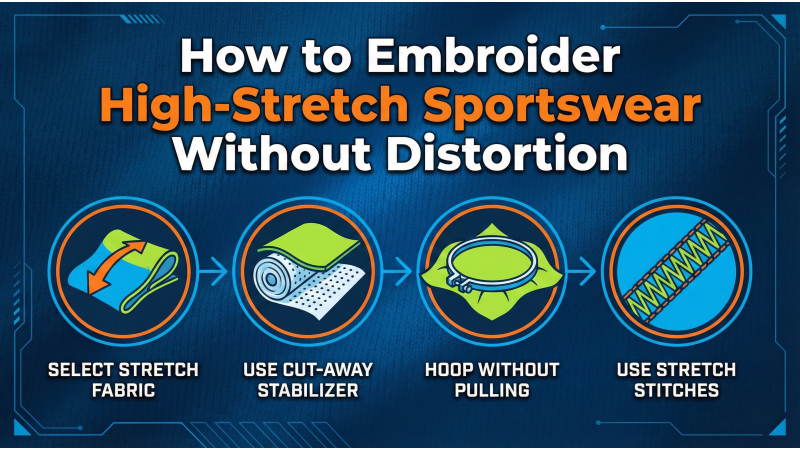
How to Embroider High-Stretch Sportswear Without Distortion
High-stretch sportswear behaves like a living surface — it breathes, flexes, rebounds, and resists anything that tries to tame it. Spandex, lycra, performance jerseys and compression fabrics are gorgeous on the body but notoriously fussy under the needle. Without the right stabilizer, hooping discipline, and density strategy, embroidery can warp, ripple, sink or create stiff “islands” that fight the fabric’s natural movement.
This guide expands your toolkit with deeper technique, richer troubleshooting logic, and reliable references. To explore more stabilizer-to-fabric pairings, you can also check resources like Bernina’s stabilizer material guide, which offers solid examples of how certain backings interact with knits and stretch performance fabrics.
Why Stretch Fabrics Misbehave
Stretch fabrics are knitted, not woven. They contain elastane fibers engineered to recover after movement. When embroidery introduces dense thread structures, those stitches restrict the fabric, causing distortion or “draw-in.” The artwork then looks squeezed, off-shaped, or sunken. Most problems originate in four areas:
- Weak or inappropriate stabilizer support
- Poor hooping technique causing stretch memory
- Inefficient digitizing (wrong underlay, excessive density, long satins)
- Needle and tension mismatches
Step 1 — Choose the Right Stabilizer
Stabilizers are the foundation that prevent stitches from collapsing into the fabric. For more inspiration on stabilizer behavior with tricky textiles, explore the curated embroidery tips library by Ricoma.
Cut-away stabilizers: The gold standard for sportswear. They remain behind the design permanently and prevent distortion during wear, wash and stretch. Choose soft or “no-show” cut-away for lightweight jerseys.

Stretch-specific backings: These are engineered to move with the garment. Their flexibility stops the embroidered area from becoming a stiff patch.
Avoid tear-away: Tear-away often rips under the stress of dense satins and is too weak for elastane-rich fabrics.
Topping for clean details: A water-soluble topping prevents the stitches from sinking into napped or open knits, improving clarity. Additional examples for fabric-specific embroidery adjustments appear in the OESD special-fabrics embroidery guide.
Step 2 — Digitizing Without Fighting the Fabric
Digitizing for stretch means creating a structure that cooperates with elasticity rather than overpowering it.
- Underlay: Use edge-run underlay for satins and zig-zag or triple-run underlay for fills. They anchor the shape and prevent pull-in.
- Lower density: Reduce density by 5–10% to maintain flexibility and prevent puckers.
- Shorter satins: Long satins distort easily on stretchy garments. Break them into sections or convert to stepped satins.
- Contour and shape-aware fills: Let fills follow the fabric’s stretch direction, reducing stress lines.
- Thoughtful sequencing: Anchor key elements first before layering decorative details.
For creative examples of flexible artwork styles that adapt well to stretchy surfaces, you may enjoy watching how designers approach stitch behavior in videos such as this embroidery method walkthrough.
Step 3 — Needles, Threads & Machine Tension
Choosing the wrong needle is often the invisible culprit behind distortion.
- Ballpoint/stretch needles: Sizes 75/11 or 80/12 prevent cutting through knit loops.
- Polyester thread: Polyester is flexible, durable, and colorfast — perfect for sportswear.
- Bobbin thread: Stick with polyester bobbins for improved resilience.
- Tension: Reduce top tension slightly if the fabric is pulling inward.
If you want to see real-time examples of how thread type affects elasticity, this thread-behavior demonstration provides a useful visual reference.
Step 4 — Hooping Without Stretching
Hooping incorrectly is the fastest way to distort a design, even if everything else is perfect.
- Hoop the fabric relaxed — never stretched.
- Use adhesive stabilizer or temporary spray to hold slippery fabrics in place.
- For tubular items (leggings, sleeves), use magnetic or specialty hoops.
- Pre-test placement using templates, not tension.
Step 5 — Smart Placement & Sizing
Stretch garments have zones of high stress — center chest, side torso panels, waistlines, and compression zones. Avoid placing dense motifs here. Instead:
- Use lighter, open designs in high-movement regions.
- Avoid small, dense motifs — they behave poorly under stretch.
- Test proportions on scrap fabric from the same garment batch.
Step 6 — Floaters, Toppings & Extra Support
Floaters act like temporary scaffolding that keep stitches upright during embroidery:
- Water-soluble topping for clarity
- Thin cut-away laid over fabric to prevent sink-in
- Low-tack adhesive sprays for jerseys that shift easily
Step 7 — Control Speed & Trim Carefully
On stretch fabrics, gentle machine speed produces far more consistent results. Jump stitches should be trimmed close to prevent snagging during wear. Slow down for dense areas or satin-heavy regions.
This machine-speed and stitch-quality lesson gives a clear look at how slower stitching improves accuracy on unstable fabrics.
Step 8 — Finishing That Preserves Stretch
Finishing is where longevity is decided:
- Trim cut-away close but do not remove it entirely.
- Use soft silicone or heat-set finishes sparingly to improve comfort.
- Secure thread ends with lock stitches.
- Do wash and stretch testing before production runs.
Troubleshooting Guide
Puckering: Usually caused by fabric being stretched in the hoop or by excessive density. Re-hoop relaxed and adjust density.
Stitches sinking in: Add topping or a lightweight floater on top.
Design feels stiff: Lower density; use softer backings.
Frequent thread breaks: Switch to ballpoint needles, reduce speed and verify smooth thread path.
Testing & Quality Control Checklist
- Test on scrap from the same garment batch.
- Stretch test in all directions — stitches should rebound cleanly.
- Wash/dry according to care label instructions.
- Perform simulated wear testing.
Pro Tips From Experienced Digitizers
- Use simpler, cleaner shapes — they behave better on stretch fabric.
- Let fills contour to natural fabric movement.
- Combine embroidery with patches or prints for ultra-stretch zones.
- Document stabilizer, tension, and density settings for repeatability.
Conclusion
Embroidering stretchy sportswear becomes reliable once you treat the fabric as a flexible partner rather than a stubborn opponent. Select cut-away stabilizers meant for stretch, digitize with lower density, hoop gently, use ballpoint needles, control machine speed, and test relentlessly. With these practices, your embroidery will stay crisp, flexible, and durable — even after countless workouts and washes.
FAQ
Can I remove cut-away later? Not recommended — it preserves shape and long-term stability.
Is embroidery or print better for stretch garments? Both have roles. Embroidery adds a premium touch; prints flex more freely. Choose based on area and purpose.
Before scaling production, create a pilot batch of 5–10 pieces, log the stabilizer and tension settings, and evaluate wash-and-wear performance. These small precautions save hours of rework later.
Leave a comment