





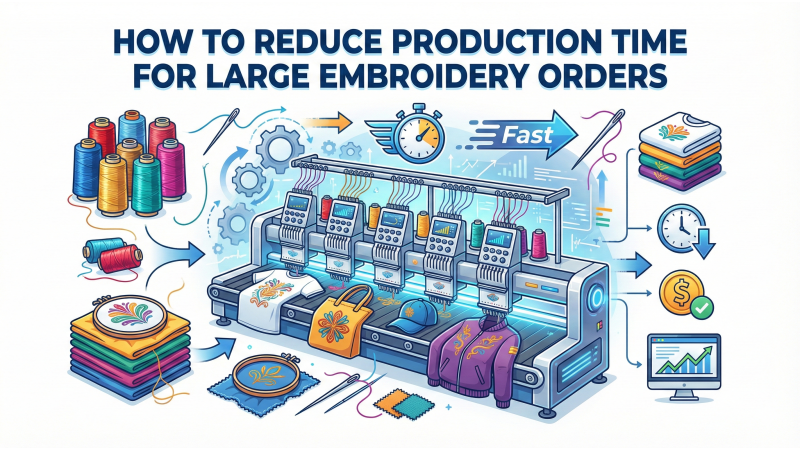
How to Reduce Production Time for Large Embroidery Orders
Large embroidery orders offer excellent profit potential, but only when your production workflow runs with precision. Delays caused by inefficient digitizing, frequent color changes, unoptimized hooping, and slow operator handling can quickly eat into your margins. To keep quality high and turnaround times low—especially in high-demand regions such as the USA, Canada, Europe, the Middle East, Africa, Australia, and Asia—your workflow must be organized, standardized, and optimized for speed.
This guide integrates expert-backed strategies used by commercial embroidery shops worldwide, supported by practical insights from digitizing specialists, workflow trainers, and real production environments.
Start with Efficient Digitizing
Digitizing is the foundation of production speed. A design that’s poorly digitized—with unnecessary trims, jump stitches, or density overload—slows the entire process. To improve digitizing efficiency, review this comprehensive breakdown of digitizing principles and pro techniques: digitizing fundamentals and pro-grade methods.
For large-scale production specifically, understanding digitizing’s role in run time efficiency is essential. This detailed explanation gives great insight into how digitizing directly impacts output speed: digitizing for high-volume embroidery.

Optimize Color Changes and Thread Pathing
Color changes are one of the biggest contributors to production delays. Modern embroidery software and machines allow you to reorganize color sequences so the needle operates with minimal interruptions. To refine your workflow even further, check out this productivity guide crafted specifically for commercial embroidery: efficient workflow practices for commercial shops.
To visualize this in action, watch this helpful walkthrough demonstrating practical pathing and color management techniques: real-time thread routing and sequencing tutorial.
Batch Similar Items Together
Batching is an essential time-saver in large production runs. Grouping garments by color sequence, hoop size, stabilizer type, or design variations prevents unnecessary adjustments between cycles. Batching significantly reduces both downtime and production errors.
For shops looking to streamline batch-based workflows further, explore this advanced production guide: speed, workflow, and frame optimization strategies.
Improve Hooping Speed with Better Tools
Hooping often consumes more production time than stitching. Using magnetic frames, hooping stations, and multi-setup rigs cuts hooping time significantly. Proper hoop tension also reduces thread breaks, puckering, and rework.
This demonstration video shows how professionals accelerate hooping while maintaining precision: faster hooping techniques.
For more speed-focused operational methods, explore this visual guide: rapid workflow improvements for embroidery shops.
Use Multi-Head or Multi-Machine Setups
To accelerate production, multi-head machines or banks of synchronized single-head machines are essential. They multiply output without increasing supervision time. Keeping all machines calibrated equally ensures design consistency across hundreds of garments.
For a better understanding of multi-machine coordination, watch this workflow-focused explanation: multi-head and multi-machine production efficiency.
Maintain Machines Regularly
Machine downtime is one of the costliest setbacks in large orders. Daily lint removal, frequent needle changes, tracking thread condition, and proper lubrication ensure uninterrupted production. Regular maintenance prevents stoppages and keeps stitching smooth even during long runs.
Use Production-Friendly Designs
Some designs simply aren’t efficient for large runs. Dense fills, excessive satin borders, and multi-color layering slow output. Offering clients a simplified, production-friendly design variation reduces run time and improves consistency—especially when filling large uniform orders for corporate, hospitality, sports, or retail sectors.
Train Operators for Speed and Accuracy
Skilled operators can spot tension issues early, hoop faster, troubleshoot quickly, and maximize machine uptime. Operator training should focus on threading efficiency, tension balancing, color change coordination, and on-the-fly corrections.
Use Tools to Preview and Verify Designs
Previewing a design in software allows you to catch errors, eliminate unnecessary movements, and reorganize color sequences before sending it to the machine. This reduces rehooping and prevents misalignment during batch production.
Automate Wherever Possible
Automation is a major time-saver for large orders. Auto-trim features, automatic thread detection, preset needle arrangements, and organized material stations significantly speed up each production cycle. When stabilizers, bobbins, hoops, and garments are placed within arm’s reach, operators work faster and more efficiently.
Use Video Tutorials for Faster Learning
Visual learning accelerates skill development. Workshops and video tutorials demonstrate real-world techniques for speed and accuracy, making them valuable for new and experienced operators alike. This detailed video offers a strong overview of speed-focused embroidery production: visual production speed training.
Conclusion
Reducing production time for large embroidery orders requires a combination of smart digitizing, streamlined batching, efficient hooping practices, multi-machine planning, skilled operators, and consistent maintenance. When you integrate these methods—supported by modern workflow tools and expert tutorials—you accelerate production without sacrificing quality. This ensures faster delivery, higher profit margins, and increased client satisfaction across global embroidery markets. With an optimized system in place, your shop can confidently take on large, recurring, and high-volume orders with ease.
Related Products


Leave a comment