





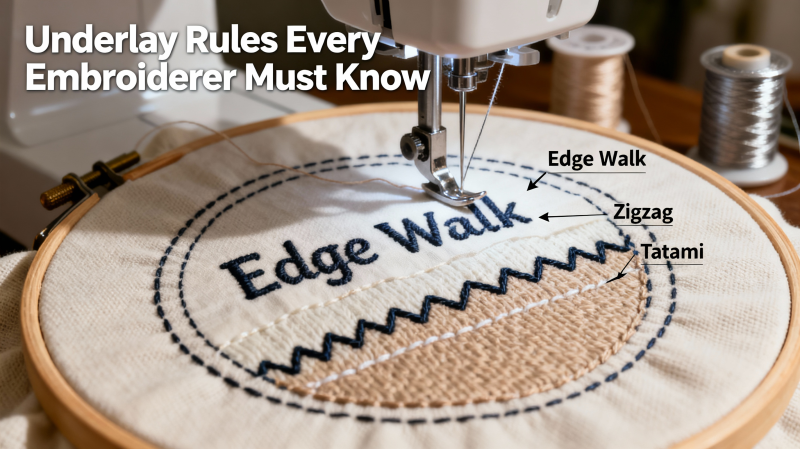
Underlay Rules Every Embroiderer Must Know to Fix Design Quality
Underlay stitches are the invisible foundation of every professional embroidery design. Whether you use a home machine or commercial equipment, your design quality depends heavily on the correct underlay. Wrong underlay leads to distortion, uneven fills, gaps, fuzzy outlines, and puckering—even with perfect tension.
This guide explains the underlay rules that every embroiderer and digitizer must understand to fix design quality issues before they happen.
What Is Underlay in Machine Embroidery?
Underlay stitches are low-density foundational stitches placed beneath the top stitching. They create stability, control movement, improve coverage, and define shape. Good underlay compensates for fabric stretch, nap, and pull, leading to clean, crisp embroidery.
For more foundational details, check out this explanation: The Embroidery Coach – Why Underlay Stitching Is Important
Why Underlay Matters for Design Quality
- Prevents fabric shifting
- Reduces push–pull distortion
- Enhances coverage, especially on stretchy or textured fabrics
- Locks the outline in place
- Helps maintain crisp edges and sharp details
- Prevents fill stitch gaps and holes
Learn more about how underlay influences digitized design performance: Embroidery Legacy – Underlay in Embroidery Digitizing

Types of Underlay Stitches (And When to Use Them)
1. Center Walk Underlay
Best for: Lightweight fabrics, satin stitches, scripts, small text.
This simple run stitch stabilizes the shape and prevents wobbling.
2. Zigzag Underlay
Best for: Medium to large satin stitches.
Provides width, lifts the top stitches, and gives smoother coverage.
3. Double Zigzag Underlay
Best for: Puffy foam embroidery, thick satin borders, caps.
Creates volume and ensures clean cuts on foam.
4. Edge Walk Underlay
Best for: Satin outlines, lettering, borders.
Secures edges to prevent outline shifting.
5. Tatami (Grid) Underlay
Best for: Large fill areas, textured fabrics, stretchy knits.
Covers the surface, locks down nap, and prevents fabric highlights.
For a detailed breakdown of underlay choices: Hatch Embroidery – Choosing the Right Underlay
Underlay Rules Every Embroiderer Must Follow
Rule 1 — Match Underlay to Fabric Type
Stable fabric = less underlay Stretchy fabric = more underlay
Useful guide: Cre8iveSkill – Guide to Underlay Stitches
Rule 2 — Do Not Skip Underlay on Knits or Stretchy Fabric
Tatami + edge-walk prevents distortion and gaps.
Rule 3 — Use Edge-Walk Underlay for Any Design with Borders
This ensures the outline always aligns perfectly.
Rule 4 — Use Double Zigzag for Puffy Foam
Creates clean, smooth dimensional embroidery.
Rule 5 — Underlay Density Must Be Low
Underlay should create stability without adding bulk.
Rule 6 — Use Multiple Underlay Layers When Needed
For tough fabrics like towels or fleece: Edge-walk + zigzag + fill underlay = perfect coverage.
Video: Visual Guide to Underlay Types
Watch this video to see how different underlay types appear and why they affect quality:
Additional Underlay Resources
Final Thoughts
If you want crisp outlines, clean fills, and professional-quality embroidery, underlay is essential. It is the hidden structure holding the entire design together. Once you master underlay rules, your design quality will improve dramatically—even before adjusting tension, density, or speed.
Related Products




Leave a comment