





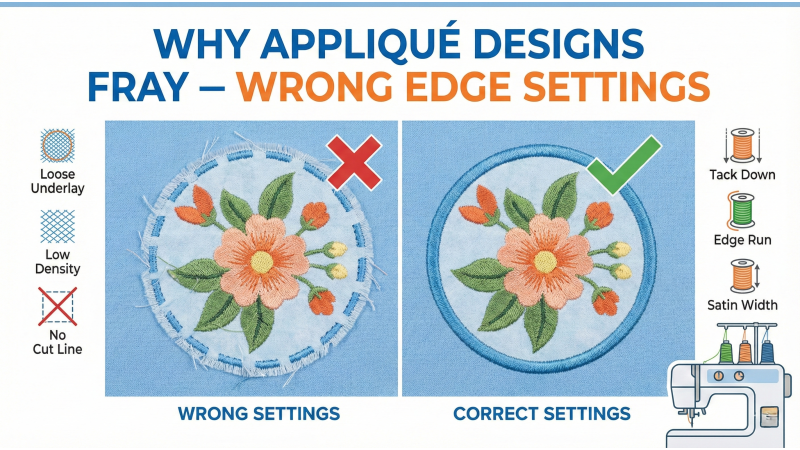
Why Appliqué Designs Fray — Hidden Digitizing Mistakes & How to Fix Them
Appliqué embroidery looks beautiful when done right, but when the edges begin to fray, show loose fibers, or look fuzzy after stitching, the final result becomes frustratingly unprofessional. Many embroiderers assume that trimming, fabric quality, or machine tension is the culprit. In reality, fraying almost always comes from incorrect digitizing settings. Understanding these settings deeply — edge width, density, underlay, pull-compensation, fabric choice, and tackdown — is the key to creating appliqué that stays clean and durable.
If you're new to appliqué troubleshooting, resources like the guide from Designs By Juju’s appliqué troubleshooting blog offer a great overview of the common mistakes beginners make. For deeper technique explanations, the MaggieFrame appliqué mastery guide walks through tools, trimming methods, and stabilizers that help prevent edge issues before they start.
Video learners can also benefit from step-by-step appliqué demonstrations such as this appliqué tutorial on YouTube, which visually shows how satin borders behave, or this beginner-friendly appliqué process video that highlights fabric trimming accuracy. For more complex shapes or layering techniques, this advanced appliqué walkthrough is extremely useful. If you struggle with stitch clean-up or corner shaping, this appliqué precision-cutting and edging demo provides practical finishing tips.
1. Wrong Satin Edge Width
The satin border is the main element that seals in the raw appliqué fabric. When the satin width is too narrow, inward stitch pull causes the border to shrink even more, exposing fibers. Many digitizers stick to a default 2.0–2.5 mm, not realizing it is too narrow for real stitching, especially on textured or thick fabrics.
- Ideal satin width for most fabrics: 3.0 mm – 4.0 mm
- For thick fabrics (felt, fleece, denim): 4.5 mm or wider
A wider satin border allows comfortable overlap over the appliqué edge and eliminates nearly all fraying in everyday embroidery and washing.
2. Missing or Weak Underlay
Underlay stabilizes the appliqué foundation and prevents the satin stitches from collapsing or slipping off the fabric. Using only a weak center-walk underlay is one of the biggest reasons appliqué edges unravel.
Strong underlay combination for appliqué:
- Edge-run underlay
- Zig-zag underlay
These two together reinforce the entire border shape and give the satin stitches a solid structure to grip onto.

3. Low Satin Density
Low-density satin causes thin coverage, gaps between stitches, and weak downward pressure on the appliqué fabric. Even before the design completes stitching, the raw fabric may already be exposed.
Recommended satin density: 0.35 mm – 0.40 mm
This range creates smooth, tight stitching that fully covers the fabric edge.
4. No Pull-Compensation Applied
Pull-compensation counters the natural inward shrinking of satin stitches. Without extra width added via pull-compensation, satin outlines fall short of the appliqué edge, leaving fibers visible.
Fix: Add 0.2 – 0.4 mm pull-compensation on both sides of the satin.
With pull-compensation, even after shrinking, the stitches still land correctly over the fabric edge.
5. Incorrect Cutting Method
Even perfect digitizing cannot fix poor trimming. If the appliqué fabric is cut too far from the tackdown stitch, loose fabric fibers can escape. If trimmed too close, the tackdown is weakened and may peel up during stitching.
Correct trimming:
- Use curved appliqué scissors
- Trim 1–2 mm outside the tackdown stitch
- Avoid cutting frayed or damaged fabric edges
6. Fabric Prone to Fraying
Some materials naturally fray faster — linen, loosely woven cotton, raw-edge fabrics, and decorative craft textiles. These require stronger satin borders and more supportive underlay.
For high-fray fabrics:
- Use satin 4.0–5.0 mm wide
- Increase zig-zag underlay density
- Add fusible backing for stability
7. Incorrect Tackdown Stitch
The tackdown stitch secures the appliqué before the satin is added. If it is too loose or not shaped properly, the appliqué shifts, exposing edges.
Recommended tackdown options:
- Running stitch (for stable fabrics)
- Zig-zag tackdown (for slippery/stretch fabrics)
- Width: 1.5–2.5 mm
8. Using Satin on Very Small or Sharp Corners
Tight corners and tiny shapes can’t handle satin

Leave a comment