





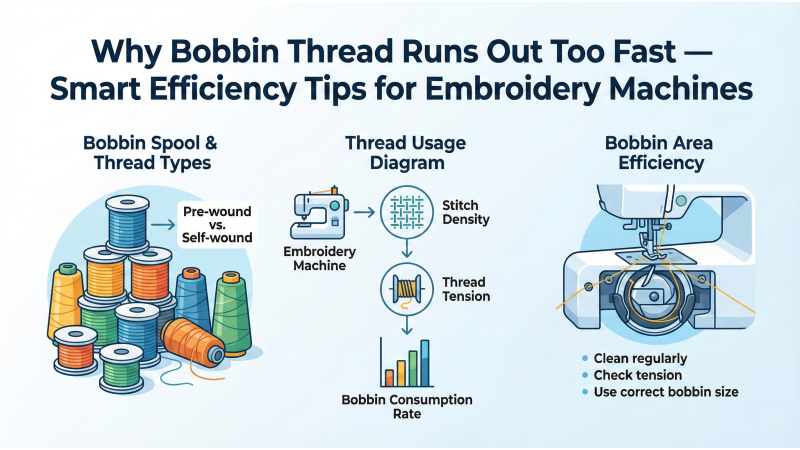
Why Bobbin Thread Runs Out Too Fast — Professional Efficiency Guide
When the bobbin runs out faster than your patience, embroidery stops feeling like a craft and starts feeling like a riddle whispered by your machine. Fast bobbin consumption interrupts workflow, causes misalignment during restarts, and slows production for both beginners and advanced embroiderers. While many assume the bobbin simply holds too little thread, the real reasons usually hide in tension imbalance, density overload, thread quality, or machine setup.
This extended guide explores every major cause of excessive bobbin usage and shows you how to significantly extend bobbin life using professional embroidery practices. Every solution is practical, realistic, and tested across multiple machine types — perfect for both home embroiderers and production environments.
For more troubleshooting inspiration, tutorials, and design insights, feel free to explore the EmbDesignTube Blog.
Reason 1: Upper Thread Tension Is Too Tight
When the upper thread tension is too tight, the machine tries to create balanced stitches by compensating — and this compensation pulls more bobbin thread upward. This imbalance makes your bobbin empty two or even three times faster than expected.
- Loosen the upper tension slightly and test stitch a small sample.
- Inspect for thread snagging along the path.
- Ensure your top thread thickness is correct for your project.
- Use smooth, high-quality embroidery thread.
For a visual walkthrough on tension correction, this video helps clarify key adjustments:
YouTube: Understanding Upper Thread Tension
Reason 2: The Bobbin Is Not Wound Correctly
A bobbin wound incorrectly behaves like a tiny, unpredictable spring. Soft, uneven, or spongy winding causes tension fluctuations that make the machine consume extra bobbin thread to compensate.
- Use pre-wound bobbins for even tension and longer run times.
- Maintain consistent tension when winding manually.
- Never use loose or unevenly wound bobbins.
- Fill bobbins to the recommended height only.
For deeper bobbin-winding efficiency tips, this detailed tutorial is extremely useful:
Master Bobbin Techniques for Perfect Stitching
Reason 3: Heavy-Density Designs Consume More Bobbin Thread
High-density designs — with large fill areas, thick satin borders, 3D puff details, or layered appliqué — naturally consume more bobbin thread. Many embroiderers think their bobbin is “finishing too soon,” but dense design structure simply requires more thread.
- Reduce density in overly compact sections.
- Use efficient underlay stitching.
- Select lighter fill patterns when possible.
- Simplify overly complex artwork.
For a clear breakdown of density-related thread usage, this video is especially insightful:
YouTube: Understanding Density & Thread Consumption
Reason 4: Using the Wrong Bobbin Thread Type
Bobbin thread comes in different thicknesses. Using a thicker bobbin thread — like matching 40wt to your top thread — significantly reduces how much thread fits in your bobbin. This results in faster emptying and frequent stops.
- Use lightweight bobbin thread (60wt–90wt) for maximum runtime.
- Avoid 40wt bobbin thread unless absolutely required.
- Use high-quality polyester threads for consistency.
For more guidance on choosing the correct bobbin thread, explore this complete bobbin troubleshooting guide:
Fix Loose Bobbin Thread — Step-by-Step Solutions
Reason 5: Incorrect Bobbin Tension
If your bobbin tension is too loose, the machine will pull out more thread than necessary during each stitch, causing the bobbin to empty prematurely. A loose-tension bobbin also leads to inconsistent stitches and visible bobbin on the top side.
- Use a bobbin tension gauge whenever available.
- Inspect the bobbin case for worn springs or damage.
- Adjust tension gradually, making very small movements.
This video gives a clear demonstration of proper bobbin tension and testing:
YouTube: How to Adjust Bobbin Tension Properly

Reason 6: Machine Speed Too High
Running your machine too fast — especially above 800 stitches per minute — creates tension fluctuations. During high-speed stitching, the machine frequently compensates by feeding extra bobbin thread, leading to waste and shorter bobbin lifespan.
- Lower to 500–700 spm for dense designs.
- Use slower speeds for knits, satin, fleece, or stretchy fabrics.
- Increase speed only for low-density patterns.
This helpful high-speed machine behavior tutorial explains why speed control is essential:
YouTube: How Speed Affects Thread Tension & Consumption
Reason 7: Cheap or Low-Quality Thread
Cheap thread has irregular thickness, causing the machine to pull more bobbin thread to maintain balance. Some low-quality threads even shed fibers into the bobbin area, increasing friction and accelerating thread consumption.
Fix: Always use clean, smooth, premium-quality bobbin thread to ensure consistent feeding and longer runtime.
This tutorial breaks down thread quality issues and their impact clearly:
YouTube: Why Thread Quality Matters in Embroidery
Bonus Efficiency Tips — Extend Bobbin Life Dramatically
1. Use Pre-Wound Bobbins
These offer up to three times more runtime due to denser, professional-grade winding.
2. Switch to Magnetic Core Bobbins
Magnetic cores prevent backlash and provide perfectly smooth thread release from beginning to end.
3. Minimize Jump Stitches
Optimizing color changes and reducing unnecessary jumps keeps both upper and bobbin consumption low.
4. Clean the Bobbin Case Regularly
Lint buildup increases drag, forcing the machine to pull more thread. Keep your bobbin area spotless.
5. Choose Low-Consumption Designs
Minimalist, low-density patterns are ideal for bulk production and significantly reduce bobbin usage.
6. Use the Correct Needle and Underlay
Proper needle size and strategic underlay stitching prevent unnecessary thread tension and overuse.
For a complete, visually guided explanation of advanced bobbin efficiency, this video walks through practical steps:
YouTube: Practical Bobbin Efficiency Techniques
Conclusion
Bobbin thread runs out too fast due to tension imbalance, incorrect winding, dense stitching, wrong thread type, or improper machine speed. Once you identify the root cause, efficiency improves immediately. Using lightweight bobbin thread, optimizing density, lowering speed, cleaning the machine regularly, and switching to pre-wound or magnetic core bobbins will dramatically extend your bobbin’s lifespan.
Build these habits into your workflow, and your embroidery will run smoother, longer, and far more consistently.
For more embroidery tutorials, digitizing tips, and troubleshooting guides, visit EmbDesignTube.

Leave a comment