





Why Clients Complain About Stitch Thickness — Fixing Customer Expectations
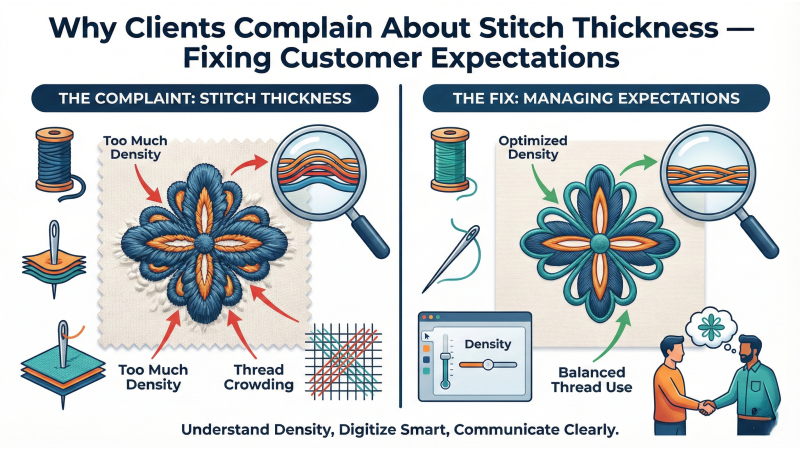
In an embroidery studio, complaints about “too thick stitches” arrive like unexpected weather. Sometimes the concern is justified, but more often it’s a mismatch between what a client imagines and how thread behaves when it settles into fabric. Embroidery is a textured craft—tiny arcs of fiber building up into form—so it will never sit as flat as ink or pixels. This extended guide unpacks the real technical factors that cause thickness, why customers perceive bulk even when the stitch file is perfect, and how smart communication can prevent most issues before a needle ever moves.
1. When Does Stitch Thickness Become a Real Technical Problem?
Before assuming the issue is “just a misunderstanding,” it’s essential to check whether the density or structure of the design truly is excessive. Several factors can create unwanted bulk:
- Density packed too tightly: Overlapping rows of stitches create stiffness and a heavy patch-like feel. A deeper dive into the math behind density adjustments can be found in resources such as Wilcom’s stitch density guide.
- Fabric incompatibility: Organza, rayon, and delicate silks amplify every extra thread, making density appear exaggerated.
- Improper needle size: Large needles push wider holes and bulkier thread paths into the fabric.
- Tight top tension: Compressed stitches pull inward, creating a rigid, compacted appearance.
- Underlay overload: Too many foundation layers cause thickness even before the top stitching begins. A well-rounded primer on backing and foundational stitching can be seen on this underlay and backing guide.
When several of these factors collide, embroidery becomes stiff, uneven, or overwhelmingly dense. Fortunately, these issues are solvable during digitizing or sampling.
2. Customer Expectations vs. Realistic Machine Embroidery Output
Most complaints about “thick” embroidery aren’t rooted in technical error at all—they arise from the client expecting embroidery to behave like print. Unlike screen printing or DTG, embroidery has dimensionality. A helpful reference comparing both worlds is this overview from Printify on embroidery vs. screen printing.
Common expectation mismatches include:
- Tiny fonts: Extremely thin lettering must be thickened to remain readable and prevent thread breaks.
- Pixel-level detail expectations: Thread cannot recreate microscopic digital details.
- Stretchy fabrics: Jersey and lycra exaggerate density because they flex underneath the needle.
- Comparisons with hand embroidery: Machine thread is engineered for speed and durability—not delicacy.
Without proper explanation, clients often believe these natural characteristics are errors.

3. How to Prevent Stitch Thickness Complaints Before They Happen
A. Show Samples or Digital Simulations
Nothing clarifies expectations like a physical sample—but when that’s not feasible, a stitch simulation works wonders. Visual previews help clients understand texture, bulk, and coverage before production. Videos like this stitch-density walkthrough and this visual density explanation offer helpful demonstrations for customers who prefer learning by watching.
B. Explain Density Based on Fabric Type
Fabrics don’t all obey the same stitch rules. Thick materials tolerate heavy stitching, while thin or stretchy ones require lower density. A practical explanation of stabilizer impact and fabric behavior can be supplemented with insights from DigitizingUSA’s density article.
C. Offer Stitch Thickness Options
Most studios find success offering density tiers such as:
- Standard Thickness — balanced for most garments
- Light/Thin Stitch — ideal for delicate fabrics and small text
- Bold Premium Stitch — thicker look for jackets and caps
Letting clients choose helps them feel involved and reduces misunderstandings.
4. When the Customer Is Misguided — Handling It With Professionalism
Occasionally, even perfect embroidery receives a complaint. The key is gentle clarification rather than defensiveness. Examples that help:
- Showing how major brands’ logos naturally look raised.
- Presenting before/after density adjustments.
- Explaining why overly thin stitches break easily or look uneven.
Clear, grounded conversation usually turns tension into trust.
5. Fixing True Thickness Problems Through Digitizing
If the design legitimately feels bulky, a few technical corrections work wonders:
- Reduce density
- Increase stitch length
- Use lighter underlay
- Switch to thin thread (e.g., 60 wt) — an excellent overview of its benefits is available at ThreadArt’s guide on 60 wt thread.
- Resize small text to avoid forced density
Minor tweaks often transform a heavy design into one that lays balanced and clean. For broader learning, this advanced digitizing explanation adds further clarity on controlling fill behavior.
6. Explaining Complexity to Clients Without Technical Overload
Embroidery vocabulary—density, underlay, tension, stitch length—may sound like an arcane script to customers. Translating these ideas into plain language helps maintain understanding without overwhelming them. For instance:
- “Embroidery looks raised because it’s made of layered thread.”
- “If the text is too thin, the thread may shred—so we add a little thickness to protect it.”
- “Different fabrics absorb stitches differently, so we adjust the density to match.”
Simple words create confident clients.
7. Why Managing Expectations Matters
Most disputes come from assumptions rather than workmanship. A client imagines print-flat results but receives textured embroidery—and the gap feels like a mistake. When expectations are corrected early, the entire workflow becomes easier, smoother, and conflict-free.
Benefits of clear expectation-setting:
- Fewer complaints
- Faster approvals
- Higher satisfaction
- Clearer communication
- Stronger long-term relationships
Final Thoughts
Stitch thickness complaints are common, but most are preventable. With better communication, visual previews, digitizing adjustments, and customer education, embroidery studios can reduce density-related objections dramatically. When true bulk exists, techniques such as lowering density, adjusting underlay, or using thinner thread resolve it smoothly. When expectations are the real culprit, gentle guidance works wonders.
And if you enjoy technical exploration, this thoughtful comparison on embroidery vs. printing or the foundational underlay/backing breakdown from DigitizeAreUs can deepen your understanding even further. For more embroidery tutorials and problem-solving guides, visit embdesigntube.com.
Leave a comment