





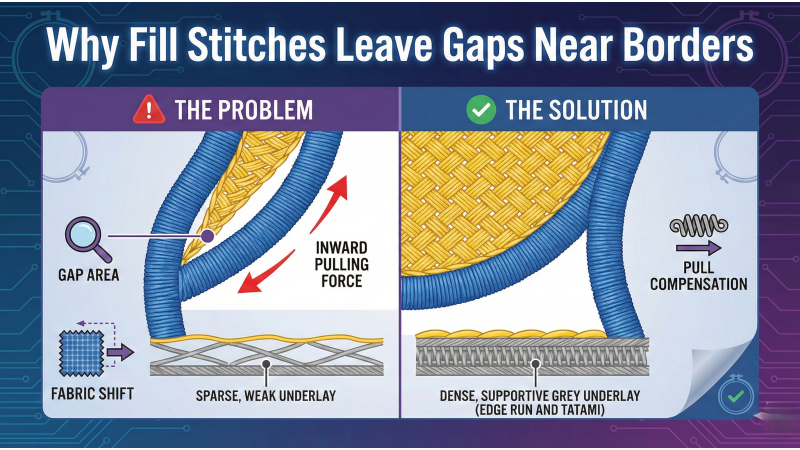
Why Fill Stitches Leave Gaps Near Borders — Complete Guide to Perfect Edge Coverage
One of the most common and frustrating issues in embroidery digitizing is when fill stitches fail to meet the borders, leaving small gaps or exposed fabric. Even when everything looks perfect in your software preview, the final stitched result often shows thin separation lines around the edges. This happens because fabric reacts under tension and embroidery stitches naturally pull inward during sewing. To understand this behavior, it helps to study how other crafts deal with edge transitions — for example, knitters carefully manage tension and pickup methods when adding borders along edges, as explained here: Picking Up Stitches Along Edges.
Fill stitches behave very differently from satin stitches. A fill area consists of thousands of directional stitches that create inward pull from multiple angles. As these stitches contract toward the center, they leave space between the fill and border. This issue becomes more noticeable on stretchy fabrics, thick garments, or large fill blocks. The only way to eliminate these gaps is to properly balance pull compensation, underlay choice, density, stitch angle, overlap, and fabric stabilization. When these elements work together, the fill will meet the outline cleanly and consistently.
1. Pull Compensation Not Set Correctly
Pull compensation determines how much extra width the software adds to counteract inward tension. If it’s set too low, the fill will shrink more than expected, creating a gap near the border. Most embroidery programs use a default value that is often insufficient for thick threads or stretchy material. A simple visual comparison also helps — the concept is similar to how knitters add extra rows or stitches at edges when demonstrating border work, like in this clear stitch tutorial video: Knitting Edge Tutorial.
As a practical guideline, adding 0.2 mm to 0.4 mm of pull compensation helps maintain proper alignment. Heavy garments like hoodies or fleece may require even more. Always test on scrap fabric to confirm the correct value before mass production.
2. Wrong Underlay for the Shape
Underlay stabilizes the fabric and supports the top stitches. Using the wrong underlay — such as relying only on center-walk underlay for large objects — allows the fabric to shift, causing gaps around the edges. Edge-run underlay anchors the fabric close to the outline, while combining edge-run and zigzag provides even better stability.
Watching how fabric behaves during needle movement can help improve your technique. This sewing-focused demonstration also shows how underlying support affects top stitching: Fabric Stabilization Demonstration.
3. Fill Stitch Angle Causing Fabric Shift
Stitch angle determines the direction of pull forces inside the fill. When the angle pushes fabric outward, distortion occurs and gaps appear on the opposite side of the border. Adjusting the stitch angle can dramatically improve the outcome. Breaking fill sections into multiple angles reduces directional tension and prevents uneven edges.
A visual example of directional pull can be seen in this instructional video that demonstrates how stitch direction affects the material: Stitch Direction Tutorial.
4. Border Digitized Too Close to the Fill Edge
Many beginners place the border exactly along the fill’s edge. In actual stitching, this creates gaps because fill stitches always shrink slightly inward. Borders should intentionally overlap the fill by 0.2 mm to 0.5 mm depending on fabric type. Satin borders require comfortable overlap, while run-stitch outlines must compensate for pull without looking bulky.
An excellent stitching technique demonstration that shows how outlines must compensate for tension is available here: Outline & Edge Stitching Tutorial.

5. Wrong Density for the Fabric Type
Stitch density determines how much the fill pulls inward. Low density causes fabric show-through near borders, while overly high density creates excessive tightening, increasing shrinkage. The ideal density for most projects is between 0.35 mm and 0.45 mm, but soft fabrics may need slightly higher coverage while stable fabrics require less. Matching density to fabric is essential to prevent distortions.
6. Fabric Stretch During Embroidery
Even perfectly digitized designs can fail if the fabric stretches in the hoop. Knit materials, hoodies, T-shirts, caps, and fleece shift under needle pressure. Using proper stabilizers — especially cutaway for stretch fabrics — prevents distortion. Avoid overstretching during hooping and consider floating additional stabilizer layers for large fills.
Final Thoughts
Fill stitches leaving gaps near borders is rarely caused by a single mistake. Instead, it results from multiple factors working against each other: fabric tension, stitch pull, underlay choice, border spacing, density, and stabilization. The good news is that once you understand how these elements interact, you can eliminate gaps completely and achieve clean, professional borders every time.
With proper adjustments and practice, your fills will consistently meet the outline with smooth, polished precision. Apply these techniques, experiment with small tests, and continue refining your approach — your embroidery quality will improve dramatically.
Leave a comment