





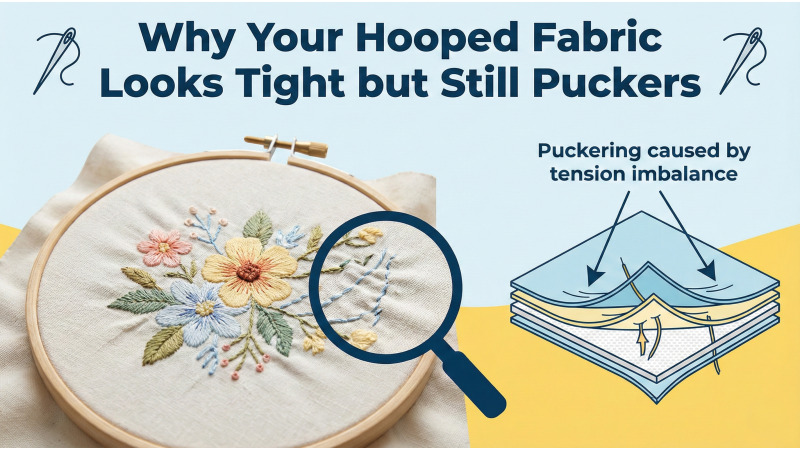
Why Your Hooped Fabric Looks Tight but Still Puckers
Everything looks calm before the needle begins its dance — fabric smooth, hoop firm, tension balanced. Yet when the embroidery is done, small ripples appear like quiet aftershocks. This is the puzzling world of puckering: the fabric swears it was ready, but the stitches pull it into uneasy waves. Understanding this tension tug-of-war is the only way to tame it.
Puckering doesn’t start on the surface; it begins underneath, where stabilizer strength, stitch density, thread tension, and needle condition conspire with fabric behavior. Even when your hooping is immaculate, internal stress can warp the result. This guide unpacks every reason behind puckering and shows how to eliminate it — so your fabric stays smooth from first stitch to final flourish.
For more fabric-behavior insights and community experiences, many embroiderers discuss similar issues on platforms like Reddit, including this discussion on why stitches create puckering.
Cause 1: Incorrect Stabilizer for the Fabric Type
A stabilizer is the unseen backbone of embroidery. When it’s weak or mismatched, the fabric shifts under the needle, creating tiny stress points that bloom into puckers after stitching. Even if the surface is firm inside the hoop, an unstable foundation will slip.
- Cut-Away Stabilizer — Ideal for knits, jerseys, and anything stretchy.
- Medium/Heavy Tear-Away — Best for stable woven fabrics and dense designs.
- Sticky/Adhesive Stabilizer — Perfect for slippery satins, rayons, and polyesters.
- Water-Soluble Topping — Helps flatten textured or high-pile surfaces.
An extended deep-dive into stabilizers can be found in guides like Embroidery Legacy’s detailed puckering-prevention article, which explains stabilizer-to-fabric matching beautifully.
Cause 2: Too Much Pulling When Hooping
Many embroiderers stretch fabric as if tuning a drum. But when stretched fabric relaxes after unhooping, the stitched areas remain locked in place. This imbalance creates radial puckers around the design.
Fix: Hoop the fabric firm but not stretched. The surface should be smooth, never distorted.
For visual demonstrations, videos like this YouTube tutorial on hooping technique show how subtle over-tensioning affects the fabric even before stitching begins.
Cause 3: Excessive Stitch Density
Each stitch is a tiny anchor pulling the fabric inward. When thousands of stitches cluster tightly, they generate internal strain. The fabric may look calm in the hoop, but once released, the design area contracts — resulting in puckering.
Fix density issues by:
- Reducing fill density.
- Using edge-run or zigzag underlay before satin or fill stitches.
- Increasing spacing on large areas.
- Choosing lighter patterns for delicate fabrics.
A great breakdown on how dense stitching affects fabric can also be seen in this StitchFloral post exploring puckering causes.
Cause 4: Incorrect Thread Tension
Thread tension is like gravity — invisible but constantly influencing the world beneath it. When upper tension is too tight, the thread yanks the fabric upward with each stitch. Even flawless hooping cannot withstand overly aggressive pull.
- Loosen upper tension slightly.
- Check bobbin tension using a gauge.
- Inspect threading path for snags or lint.
- Ensure the thread isn’t catching on rough guides or burrs.
If the tension is correct, the bobbin thread forms a perfect, balanced line beneath fill stitches — not too much, not too little.
Cause 5: Wrong Needle Size or Type
A needle that is too large or worn out pushes fabric while penetrating instead of slicing through smoothly. This drag creates distortion that appears as puckering.
- 75/11 Ballpoint — Knits and soft stretchy fabrics.
- 75/11 Sharp — Wovens and medium-weight fabrics.
- 80/12 Sharp — Medium-heavy materials.
- 65/9 — Lightweight or delicate materials.
Video breakdowns like this YouTube guide offer useful examples of needle effects on fabric movement.

Cause 6: Loose Bobbin Area or Machine Vibration
Even well-prepared fabric can misbehave when the machine vibrates or the bobbin area is not seated firmly. Movement of even half a millimeter per stitch results in subtle puckers.
- Tighten bobbin case screws.
- Seat the case correctly.
- Lower machine speed to 450–650 spm.
- Use a stable table or anti-vibration mat.
Machine vibration and carriage movement problems are also discussed in resources like this Eagle Digitizing article on embroidery quality issues.
Cause 7: Fabric Type Not Suitable for the Design
Every fabric has a personality — some playful, some stubborn, some fragile. Lightweight or stretchy fabrics cannot support heavy, dense designs no matter how perfect the setup. When the stitches overpower the material, puckering is inevitable.
Balance fabric and design:
- Avoid heavy fills on chiffon, georgette, or thin knits.
- Use lighter density for T-shirts and polyesters.
- Reserve dense stitching for denim, canvas, twill, or tightly woven fabrics.
For more visual demonstrations of how fabric reacts, videos like this tutorial on preventing fabric distortion are incredibly helpful.
Additional Tips to Prevent Puckering
- Use two stabilizer layers for stretchy or ultra-thin fabrics.
- Float the fabric on sticky stabilizer instead of hooping directly.
- Use iron-on stabilizers for extra structure.
- Prewash and press fabric before embroidering.
- Always test-stitch before final production.
For more real-world examples, troubleshooting steps, and fabric-behavior discussions, explore resources like Ricoma’s comprehensive article on embroidery puckering.
Conclusion
Puckering isn’t a surface issue — it’s a tension issue. The fabric looked perfect in the hoop because hooping only controls surface smoothness, not internal fabric stress. Every stitch pulls the fabric inward, and when stabilizer strength, stitch density, tension balance, or fabric selection fail to support that pull, puckering forms.
Once you understand this dance between stability and tension, embroidery becomes far more predictable. Choosing the right stabilizer, fine-tuning density, balancing tension, selecting the right needle, and respecting the limitations of each fabric will keep your embroidery smooth, flat, and professional.
For even more insights into puckering behavior and solutions, visit StitchFloral’s troubleshooting post to round out your learning journey.
For more embroidery tips, digitizing guidance, and downloadable designs, visit EmbDesignTube.
Related Products


Leave a comment