





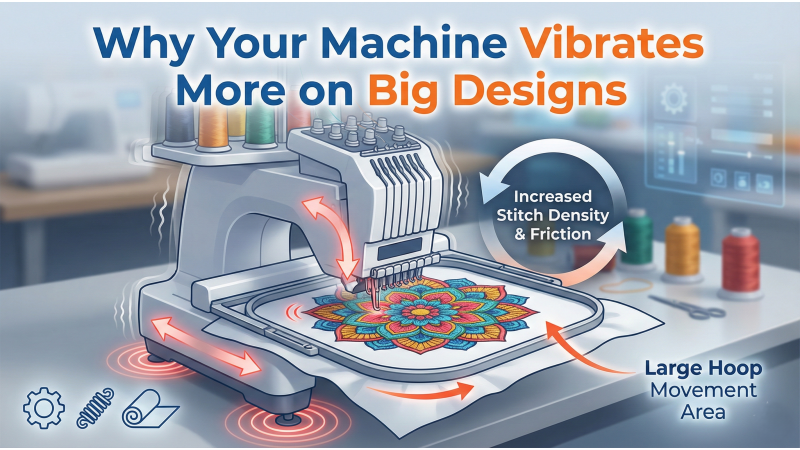
Why Your Machine Vibrates More on Big Designs — Complete Stability & Setup Guide
When stitching large embroidery designs, many embroiderers notice increased shaking, noise, or frame movement. Contrary to common belief, vibration does not happen simply because a design is big — it occurs because larger designs force the embroidery machine to work harder, move farther, and punch denser areas repeatedly. Understanding why vibration increases gives you complete control over stability, stitch quality, and machine safety.
To start with the basics, choosing the right stabilizer for large or dense designs plays an essential role in controlling movement. A helpful guide such as the Embroidery Stabilizer Guide from Designs By Juju explains how stabilizer strength influences fabric tension, hoop grip, and vibration control. Pair this knowledge with a stable machine setup and proper hooping, and even extremely large designs can run smoothly.
1. Large Fill Areas Create Heavy Downward Needle Force
Big fill blocks — background fills, large applique bases, and bold letter areas — force the needle to penetrate the same region thousands of times. Every penetration sends downward shock into the fabric, hoop, and machine body. On larger surfaces, this downward force distributes unevenly, making the entire machine vibrate.
Reducing fill density by even 10–15% and adding proper underlay (edge-walk + zigzag) reduces impact dramatically. When your design is extremely dense or heavy, double-check your frame size and stabilizer stability. A vibrating hoop is a sign the fabric is not being supported well enough.
2. Machine Table Is Not Strong or Stable Enough
Your embroidery machine table or stand is one of the biggest hidden causes of vibration. Lightweight tables bend under rhythmic motion, especially when the hoop travels widely. High-end embroiderers often use specialized anti-vibration mounts like the Dynemech Anti-Vibration Table Series to dampen shock and stabilize machine weight.
If you prefer a DIY approach, you can explore creative and stable sewing workstation builds such as the ideas at Patchwork Posse's DIY Sewing Table Concepts . A solid frame, thick wood top, and evenly balanced legs prevent almost all table-related vibration.
For an embroidery-specific vibration troubleshooting approach, this embroidery vibration reduction guide demonstrates multiple professional solutions including weight distribution, damping pads, and surface reinforcement.
3. Wide Multi-Directional Movement Causes Mechanical Shaking
Small designs move within a tight area, but large designs cause the hoop carriage to travel farther across the rails. Long diagonal motions, large jumps, and high-speed repositioning all create extra force that leads to shaking. This is why manufacturers often advise lowering speed for extra-large embroidery files.
If your hoop moves too aggressively, consult your machine’s vibration and noise FAQ like Brother’s official troubleshooting page here: Brother Machine Vibration Troubleshooting .
Reducing speed to 500–650 SPM for large designs dramatically improves stitch accuracy, outline alignment, and thread life.
4. Using a Large Hoop on Thin or Stretchy Fabric
When the hoop is large, the unsupported center area increases. Thin fabrics sag, bounce under the needle, and create instability — one of the most common reasons machines vibrate more on big designs.
Use a strong cutaway stabilizer and avoid oversized hoops whenever possible. If you struggle with hoop grip or fabric stretching, video tutorials like this stabilizer & hooping demonstration offer visual examples of how to secure fabric more effectively.
5. Machine Rails Not Clean or Lubricated
The hoop carriage rides on metal rails that collect lint, dried oil, and thread dust. When the rails are dirty, the hoop movement becomes jerky, which appears as vibration especially on larger designs.
Regularly clean the rails and apply the exact lubrication recommended by your machine brand. For help understanding how movement issues affect stitching, this short mechanical explanation video: Why Machines Shake When Carriage Movement Is Blocked can help you identify the symptoms early.

6. Stabilizer Slipping or Fabric Not Tightly Hooped
Even if the table is stable, fabric instability inside the hoop causes vibration. When fabric lifts or shifts while the needle penetrates dense areas, the hoop moves — and that movement becomes vibration.
Always hoop the stabilizer and fabric together unless floating is intentionally required. Ensure stabilizer edges do not shift or slide as stitching progresses. A slipping stabilizer is one of the fastest ways to introduce shake in large-fill designs.
7. Excessive Thread Tension Pulling the Hoop Downward
Tight top thread or bobbin tension pulls the entire embroidery surface downward. Multiply this pulling motion across a large fill block and the hoop begins to bounce or vibrate.
Balance your thread tension until the bobbin and top thread form a clean lock inside the fabric. Overly tight bobbin tension is especially common when users switch thread brands or bobbin types.
8. Heavy Garments or Multi-Layer Projects Increase Weight Shift
Jackets, hoodies, quilts, and layered applique fabrics add weight to the hoop. When the hoop moves, the heavy garment drags along with it, producing vibration that becomes more intense on wide designs.
Using hoop clamps or magnetic frame supports helps prevent shifting and maintains consistent hoop movement during stitching.
Final Advice — Test Large Designs Before Running the Final Piece
Big designs require careful preparation. Even a tiny adjustment — stabilizer weight, hoop tension, speed reduction, or underlay modification — can completely eliminate vibration. Always test your design on scrap fabric before stitching the final garment.
Most vibration issues disappear when you:
- Place the machine on a heavy, stable, non-flexing table
- Use proper stabilizer strength for large-area stitching
- Reduce fill density and optimize underlay for big designs
- Lower speed for wide movement patterns
- Clean and lubricate rails regularly
- Ensure perfect hooping and fabric stability
With the right setup, your embroidery machine can stitch even the biggest designs with minimal vibration, cleaner registration, and far smoother operation.
Leave a comment