





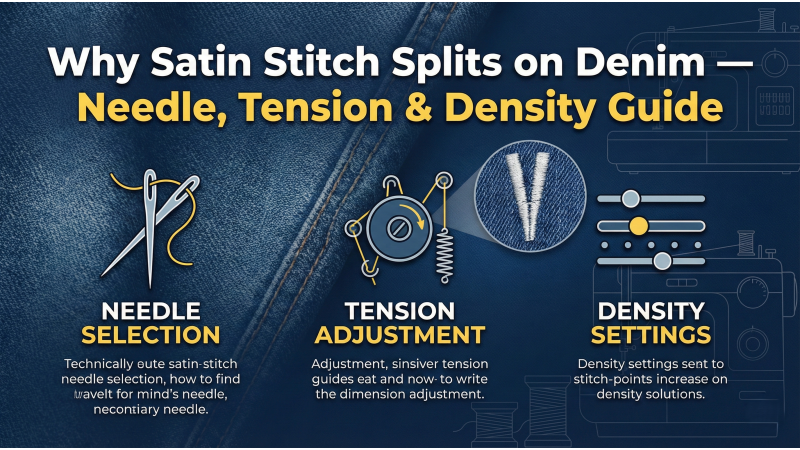
Why Satin Stitch Splits on Denim — Needle, Tension & Density Guide
Denim has the personality of a stubborn giant — thick-skinned, unyielding, and full of hidden resistance. When embroiderers try to lay smooth satin stitches across its rugged landscape, the thread can split, fray, or buckle unless the entire setup is tuned with care. This guide explores why satin stitches misbehave on denim and how to control needle choice, tension, density, stabilizers, digitizing, and machine speed to create clean, uninterrupted satin columns.
If you're diving into denim projects for the first time, this step-by-step jeans embroidery tutorial offers a great overview of handling the fabric: How to Embroider Jeans – HoopTalent.
1. Why Satin Stitches Split on Denim
Denim’s dense weave, thick fibers, and rigidity create a perfect storm for stitch splitting. The needle must push through tough layers, the thread rubs harshly against cotton fibers, and stabilizer support becomes essential rather than optional.
- Dense weave causes needle deflection.
- Fibrous texture increases thread drag.
- High tension stretches satin columns open.
- Wrong needle type damages the thread path.
- Too much density compresses stitches.
- Weak stabilizer lets the fabric shift during stitching.
Embroidered denim garments often combine multiple thick layers, and these layers behave differently under the needle. This guide from WeAllSew offers helpful insights into working with layered denim: Sewing with Denim – Tips & Tricks.
2. Choose the Right Needle for Denim Embroidery
The needle is the frontline warrior in your embroidery battle with denim. Using the wrong one guarantees thread shredding and satin splitting. A proper heavy-fabric needle pierces cleanly, guiding the thread smoothly through the fabric.
- Denim Needle (90/14 or 100/16) — Ideal for thick layers.
- Topstitch Needle (90/14) — Large eye for smooth thread flow.
- Sharp Needle — Helps pierce multi-layer seams.
A detailed needle selection chart is available here: Madeira Needle Guide.
Why the Needle Eye Matters
Narrow-eye needles create heat and friction — enemies of satin stitch quality. A larger needle eye lets thread glide freely, preventing splitting and fraying.
- Less friction → less heat
- Less heat → less shredding
- Smoother thread flow → smoother satin columns
3. Adjust Thread Tension to Prevent Splits
Denim demands lower upper tension. Too much tension stretches satin stitches apart and exposes gaps. The goal is thread harmony — balanced, even, and relaxed enough to lay smoothly on the fabric.
Signs Your Tension Is Too High
- Satin columns have visible gaps.
- Thread frays or snaps frequently.
- Stitch surface looks thin or “stringy.”
Recommended: Reduce upper tension by 10–20% when stitching on denim.
When customizing denim jackets or jeans, this WeAllSew guide also provides practical washing and handling advice: Embroidered Jeans – WeAllSew.
4. Optimize Stitch Density for Heavy Fabrics
On denim, more density doesn’t equal better embroidery. Thick fabric + high density = pressure that forces satin stitches apart.
Ideal Density for Satin Stitches on Denim
- 0.40–0.45 mm for standard satin columns
- 0.45–0.50 mm for large satin areas
- Shorter stitches for small lettering
Too much density creates internal thread friction. Too little density exposes the denim beneath. The sweet spot depends on the garment thickness and thread type.
5. Stabilizer Selection for Denim Embroidery
Even though denim feels sturdy, it shifts more than expected during embroidery. A strong stabilizer prevents movement and keeps satin columns aligned.
Best Stabilizers for Denim
- Cut-Away Stabilizer — Most stable and durable.
- Heavy Cut-Away (2–3 oz) — Ideal for jackets.
- Fusible Cut-Away — Prevents slipping and shifting.
When customizing denim garments beyond embroidery — such as patches, text, or combined sewing/embroidery projects — this resource is helpful: Tips for Customizing Garments with Machine Embroidery.
Why Tear-Away Fails on Denim
- Tears during stitching
- Allows fabric to flex → splits satin stitches
- Weakens thread support
- Causes puckering

6. Digitizing Tips to Prevent Satin Splitting
Digitizing determines how threads behave under pressure. Proper underlay, angles, and segmentation keep satin columns stable on thick denim.
Key Techniques
- Use shorter satin stitches.
- Avoid extremely wide satin columns.
- Add edge-run and zigzag underlay.
- Smooth angle transitions.
- Break wide areas into segments.
For a more technical deep dive into underlay behavior, this guide is invaluable: Hatch: Automatic Underlay Guide.
7. Thread Type & Quality
Denim’s friction demands high-quality thread. Cheap thread unravels fast under denim pressure.
- 40wt Polyester Thread — Best all-purpose choice.
- 30wt Polyester — Bold satin effect.
- Rayon — Looks beautiful but breaks easier.
8. Machine Speed & Hooping for Denim
Recommended Speed
550–700 SPM keeps stitches smooth and prevents friction damage.
Hooping Tips
- Hoop firmly, but do not overstretch.
- Use a basting box around the design.
- Magnetic or clamp hoops help with thick jackets.
For creative ways to personalize denim using embroidery techniques, here’s another inspiring project guide: WeAllSew: Embroidered Jeans.
Conclusion
Satin stitch splitting on denim isn’t a mystery — it’s a chain reaction of needle force, tension, density, stabilizer support, and design structure. Once these elements are tuned in harmony, denim stops fighting and begins cooperating, letting satin stitches glide across its surface clean and bold.
Apply the strategies in this guide and your denim projects — whether jeans, jackets, hats, or bags — will showcase crisp, professional satin embroidery that withstands wear, washing, and time.

Leave a comment