





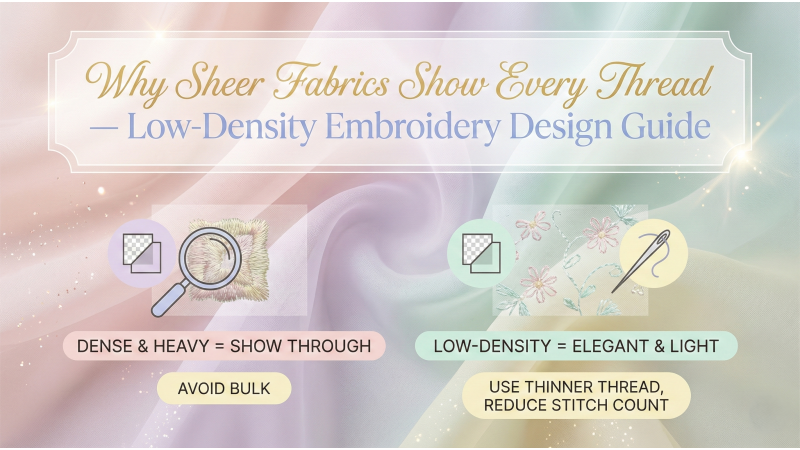
Why Sheer Fabrics Show Every Thread — Low-Density Design Guide
Sheer fabrics—organza, chiffon, georgette, tulle, mesh—behave like delicate watercolor paper. Every stitch leaves a mark, every thread casts a shadow, and every underlay becomes part of the final picture. Because they offer no thickness to hide mistakes, embroidery on sheer fabric demands an intentionally light hand and careful digitizing choices.
If you’re completely new to how stabilizers behave on delicate fabrics, this helpful foundation article from Ricoma’s Stabilizer Guide explains why transparent and lightweight textiles require special support.
1. Why Sheer Fabrics Reveal Every Thread
Unlike structured fabrics such as cotton or fleece, sheer materials are thin, soft, and translucent. When the needle pierces the fabric, you can see:
- Underlay stitches shining through the top
- Bobbin thread visible from the front
- Jump stitches casting shadows beneath the surface
- Fabric distortion caused by too many stitches
- Thread buildup behind delicate areas
A great visual explanation of this transparency challenge is shown in the technique tutorial from Needle ‘n Thread: Managing Starts & Stops on Sheer Fabric.
2. Use Low-Density Designs Made for Transparent Material
Sheer fabrics cannot tolerate heavy stitching. High-density fills compress the fabric, wrinkle it, or create visible thread shadows. The goal is softness—airy designs that look intentional rather than heavy.
Recommended Density Adjustments
- Reduce satin stitch density to the lowest safe level
- Use open-density fills rather than layered fills
- Select thinner threads (60 wt recommended)
- Avoid bold text or thick outlines unless necessary
If you’d like to see how professionals digitize airy, minimal designs for sheer material, this breakdown from Eagle Digitizing is a useful read: Light-Density Digitizing Techniques.
3. Remove Heavy Underlay — Use Light Alternatives
Underlay stabilizes embroidery, but on sheer fabrics it becomes fully visible. Instead of defaulting to standard zig-zag or fill underlay, use only what is necessary.
Underlay Options for Sheer Fabrics
- No underlay for small satin elements
- Edge-walk underlay for stability without bulk
- Extremely light zig-zag when required
A visual example of how thread foundations appear through transparent fabric can be seen in this demonstration: Underlay Visibility Test on Sheer Fabrics.
4. Choose the Correct Stabilizer
Because sheer fabrics reveal everything beneath them, your stabilizer must be invisible and supportive without leaving marks.
Best Stabilizers for Sheer Fabrics
- Water-soluble stabilizer (WSS) — ideal for transparency
- Clear film topper — prevents small stitches from sinking
- Light tearaway — only when extra support is needed
A detailed walkthrough of sheer-safe stabilizer choices is available here: Sheer Fabric Stabilizer Guide.
For advanced stabilizer layering methods used by professionals, you can also explore this deep-dive: Ultimate Guide to Sheer Fabric Embroidery.

5. Use the Right Needle and Thread
A thin fabric needs a thin needle. Larger needles create visible puncture holes and distort the weave.
Recommended Setup
- Needle size 60/8 or 65/9
- 60 wt thread for lightweight coverage
- Fine bobbin thread to reduce shadowing
To see how needle size affects fabric distortion, this practical comparison is worth watching: Needle Size Comparison for Sheer Fabrics.
6. Digitize Minimalist Designs for Best Results
On sheer fabric, less is more. Line art, monograms, delicate florals, airy motifs, and open designs look the cleanest. Avoid chunky icons, large filled areas, or dense geometric shapes.
If you want to compare how low-density stitching behaves on different transparencies, this video gives an excellent demonstration: Low-Density Stitching on Sheer Material.
Final Thoughts
Sheer fabrics reveal every thread because they provide no thickness to hide what happens beneath the surface. Mastering them means lowering density, minimizing underlay, choosing invisible stabilizers, and using fine needles and thread. When done right, sheer fabric embroidery feels weightless—like artwork floating inside the fabric rather than stitched onto it.
For extra practice and real-world demonstrations, this additional tutorial shows sheer-friendly techniques clearly: Sheer Fabric Embroidery Walkthrough.
With the right approach, embroidery on transparent fabrics becomes a graceful craft rather than a stressful one—soft, airy, and beautifully refined.
Related Products
Leave a comment