




Best Needle Types for 90% of Embroidery Projects
Selecting the right needle is a quiet decision with loud consequences. Even when your stabilizer, hooping, design density, and thread tension behave like a well-rehearsed ensemble, the wrong needle can unravel everything. A needle is the first gatekeeper of stitch quality — controlling penetration, thread flow, stitch formation, and the overall refinement of your embroidery.
Before you dive in, you can also explore a deeper foundational overview of needles by reading this helpful guide from Ricoma on choosing the right needle size .
If you’re new to embroidery or upgrading your skills, you’ll notice that almost 90% of your work can be handled with just a few essential needle types. This guide explains those core needles, how each behaves on different fabrics, common troubleshooting signs, and expert recommendations. Think of it as your stitching compass — practical, clear, and reliable.
Most Common Needle Types Used in Embroidery
Understanding your needles removes guesswork. Each type carries its own tiny personality — sharp, gentle, bold, or durable — and choosing the right one dramatically improves consistency.
1. 75/11 Sharp Needle
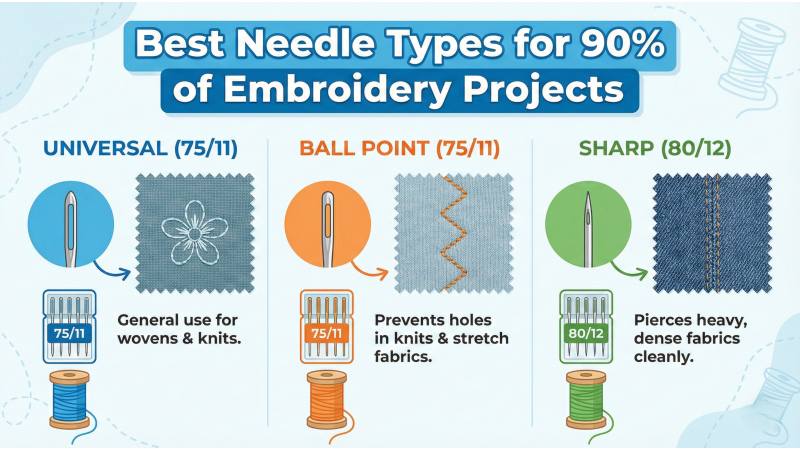
The 75/11 sharp needle is the everyday champion for light to medium garments. Its fine, precise point slices cleanly through woven fabrics, creating stable and balanced stitches. Madeira offers a great explanation of why this size is so universal in their guide on 75/11 needle basics .
You can confidently use a 75/11 sharp needle on:
- Cotton shirts
- Polyester shirts
- Light hoodies
- Woven garments
- Most flat apparel
2. 75/11 Ballpoint Needle
Stretch fabrics have their own rhythm, and the 75/11 ballpoint needle moves with them rather than fighting against the fibers. Its rounded tip gently parts yarns instead of piercing them — preventing holes, ladders, and distortion.
Best for:
- Knit T-shirts
- Sportswear & performance fabrics
- Baby apparel
- Lycra & rib-knit fabrics
If your stretch garments show tiny holes around letters or motifs, your needle type is the culprit. Kimberbell offers a beautifully simplified breakdown of needle behavior in their post on the finer points of needles .
3. 80/12 Sharp Needle
When your materials thicken just a touch — hoodies, canvas, tote bags — the 80/12 sharp needle becomes a natural upgrade. It offers more backbone without sacrificing detail.
Use an 80/12 sharp needle for:
- Medium-weight hoodies
- Canvas fabric
- Tote bags
- Polyester or nylon jackets
- Thicker woven textiles
4. 90/14 Sharp Needle
When you face dense materials — caps, backpacks, heavy jackets — the 90/14 sharp needle provides the force and stability required. Thin needles bend or break on such surfaces, but this heavy-duty partner stays solid.
Best for:
- Caps & structured hats
- Backpacks
- Thick hoodies / fleece
- Multiple stabilizer layers
- High-density designs

5. Titanium-Coated Needles
Titanium needles thrive in long production runs and high-speed setups. Their coating reduces friction and heat, which helps them survive abrasively thick or repetitive work. Metallic threads especially benefit from titanium stability.
- Commercial multi-needle machines
- Metallic-thread embroidery
- Large batch orders
- High-speed designs
- Abrasive materials
Choosing the Right Needle for Each Fabric
Use this at-a-glance guide to match needle to fabric:
- Cotton shirts: 75/11 sharp
- Polyester shirts: 75/11 sharp
- Knit/stretch fabrics: 75/11 ballpoint
- Sportswear / Lycra: 75/11 ballpoint
- Light hoodies: 75/11 or 80/12 sharp
- Medium hoodies: 80/12 sharp
- Thick hoodies / fleece: 90/14 sharp
- Caps / structured hats: 90/14 sharp or titanium
- Canvas / tote bags: 80/12 or 90/14 sharp
- Leather or vinyl: 90/14 sharp
- Towels / terry cloth: 80/12 sharp
Brother’s official support page offers a clear explanation of general needle and thread troubleshooting , which pairs beautifully with the fabric-matching list above.
How Needle Choice Affects Stitch Quality
Your needle directly influences:
- Thread flow — poor needle choice can fray thread.
- Penetration strength — thin needles flex on thick fabrics.
- Fabric protection — ballpoints prevent knit damage.
- Stitch alignment — reduces distortion in dense areas.
- Edge clarity — correct size produces smooth outlines.
When to Change Your Needle
Even the strongest needle eventually tires. You should replace your needle when you see:
- Frequent thread breaks
- Uneven or fuzzy stitching
- Puckering or fabric pulls
- Loud popping sounds during stitching
- Visible holes left in the fabric
A practical rhythm is to replace your needle every 8–10 hours of stitching, or after every major project. Titanium lasts longer but still needs timely replacement.
Helpful Video Guides
For visual learners, these two videos break down embroidery needle usage with clear demos:
- Video: Embroidery needle basics & troubleshooting
- Video: Understanding needle sizes for better results
Final Tips for Choosing the Right Needle
- Match needle size to fabric thickness
- Use ballpoints for stretch fabrics
- Use sharps for stable woven materials
- Choose titanium for long runs and metallic threads
- Go up a size for dense designs
- Replace needles routinely
The right needle simplifies your embroidery life — fewer thread breaks, tighter outlines, cleaner fills, smoother finishes, and happier customers. By learning to pair needle type with fabric behavior, you elevate your craft from the inside out.
For more embroidery guides, digitizing tips, and troubleshooting posts, explore embdesigntube.com.
Leave a comment